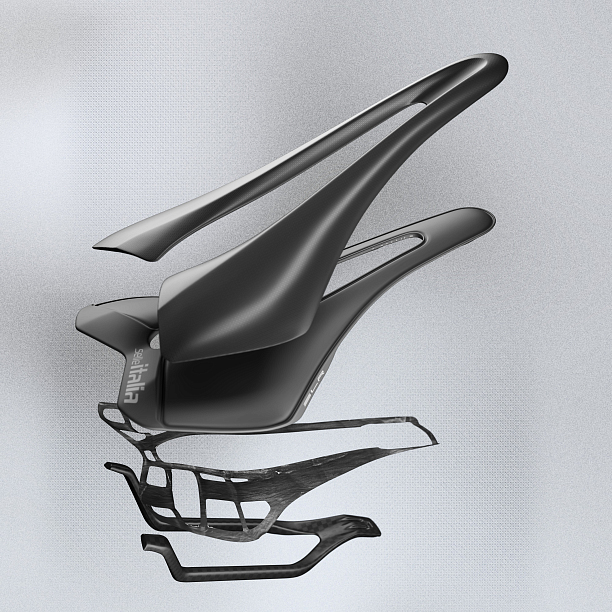
Faster. Stronger. Lighter. Fibionic’s patented FFP technology creates bionic Fiber Skeletons, enabling high-performance lightweight structures to be produced cost-efficiently at industrial scale
Current Status
11 paying customers with a Est. deal size = $13.64 M ARR
Series Production Customer Selle Italia - bicycle component manufacturer; Series Production Customer Drone Propeller;
Shoe Sole reinforcement structures: 3 customers in prototyping (brands under disclosure) humanoid robotic parts: 2 customers (brands under disclosure) bicycle parts: 5 customers (brands under disclosure) wearables: 3 big tech customers (brands under disclosure) and more (40+ qualified leads)...
Market
The global lightweight materials market exceeds USD 200 billion, creating a substantial opportunity across performance-driven industries. Our initial focus is on sports and leisure, drones and UAVs, and humanoid robotics, where low weight, high strength, and scalable production deliver immediate customer value. We are also gaining traction in consumer electronics. Over the longer term, we will expand into additional high-value segments, including automotive, aerospace, industrial machinery, medical technology, and defense. Over the next year, in-house production will serve customers and validate our industrial capabilities. From 2027 onward, we will scale globally through a solution sales model encompassing machinery, software, and materials, shortening time-to-market and generating recurring licensing and supply revenues.
Problem or Opportunity
Lightweight composites remain niche because today’s manufacturing methods are too slow, costly, and wasteful for mass production. Long cycle times, expensive tooling, manual labor, and material waste keep automotive, UAV, and consumer-electronics manufacturers reliant on metals and plastics.
The missing link is a scalable, cost-efficient, and sustainable technology that bridges prototyping and mass production.
fibionic enables high-speed, zero-waste production of bionic composite structures in under one minute and at cost parity with aluminum, removing key barriers to high-volume adoption.
Solution (product or service)
Lightweight composites remain niche because today’s manufacturing methods are too slow, costly, and wasteful for mass production. Long cycle times, expensive tooling, manual labor, and material waste keep automotive, UAV, and consumer-electronics manufacturers reliant on metals and plastics.
The missing link is a scalable, cost-efficient, and sustainable technology that bridges prototyping and mass production.
fibionic enables high-speed, zero-waste production of bionic composite structures in under one minute and at cost parity with aluminum, removing key barriers to high-volume adoption.
Competitors
fibionic’s patented fibionic fiber placement (FFP) process fundamentally changes how composite parts are produced. It merges bionic fiber-path design with the world’s fastest fiber placement technology, capable of manufacturing fully optimized, recyclable reinforcement skeletons in under one minute per part. Compared to conventional methods such as 3D fiber placement, TFP, or thermoforming (organosheets), fibionic delivers 10× faster cycle times, zero material waste, and cost parity with aluminum. This combination of speed, precision, and sustainability enables composites to move from niche, low-volume production into mainstream industrial manufacturing. The ability to integrate seamlessly with injection molding and compression processes makes FFP compatible with existing infrastructure, removing a major adoption barrier
Advantages or differentiators
fibionic’s patented fibionic fiber placement (FFP) produces optimized, recyclable reinforcement skeletons in under one minute. Compared with 3D fiber placement, TFP, and organosheet forming, it offers up to 10× faster cycles, zero material waste, and cost parity with aluminum. Integration with existing injection-molding and compression processes removes a major adoption barrier and enables composites to move from niche applications into mainstream, high-volume manufacturing.
Finance
fibionic operates a multi-tiered business model combining prototyping services, in-house serial production, and a solution sales model. The latter includes the sale or licensing of machines, software, and optimized materials, enabling customers and partners to implement fibionic’s technology in their own production lines. Early market penetration is achieved through prototyping projects (6–8 weeks), converting pilot customers into serial business. In parallel, fibionic collaborates with machine builders and material suppliers to scale globally through regional manufacturing partners. This hybrid approach accelerates adoption while maintaining technology control. The go-to-market strategy focuses on early adopters in performance-driven sectors before expanding into cost-sensitive, high-volume industries. Combined, these steps establish fibionic not just as a supplier, but as a technology enabler setting new standards for scalable lightweight production.
Business model
fibionic combines paid prototyping, in-house serial production, and solution sales. Projects lasting 10 weeks convert pilot customers into serial business. Machinery, software, and optimized materials are then sold for customer production lines. Partnerships with machine builders, material suppliers, and regional manufacturers enable global scale while fibionic retains technology control. The strategy starts with performance-driven early adopters before entering cost-sensitive, high-volume sectors.
Like any deep-tech company introducing a new manufacturing technology, fibionic faces execution and market-adoption risks. The key challenge is not whether lightweighting and automation are needed, but how quickly industries adopt new production technologies and integrate them into established manufacturing processes.
Competitive pressure may increase as composites, additive manufacturing, and automated fiber technologies continue to evolve. However, we see this as validation of a growing market. fibionic differentiates itself through its patented Fiber Placement technology, combining high-performance continuous-fiber structures with short cycle times, automation, and cost-efficient scalability.
Macroeconomic downturns could temporarily delay customer investments and industrialization programs. At the same time, the broad applicability of our technology across sports & leisure, robotics, mobility, UAVs, consumer products, and other industries reduces dependency on a single market.
The main risk therefore lies in the speed of commercialization and industrial scale-up rather than in the underlying need for lighter, stronger, and more resource-efficient structures. Our strategy is to mitigate this through diversified applications, strong IP protection, close customer collaboration, and a scalable technology platform.
Incubation/Acceleration programs accomplishment
We participated in the Unternehmertum Accelerator Program: https://accelerator.unternehmertum.de/