
64631
Sellora Ltd
The launch of a 100% remote BPO company in Mauritius.
Mauritius
Market: Telecommunications, Transport, Tourism, sport, Services, Virtual and Augmented Reality
Stage of the project: Prototype or product is ready
Date of last change: 09.10.2026
Mauritius
Market: Telecommunications, Transport, Tourism, sport, Services, Virtual and Augmented Reality
Stage of the project: Prototype or product is ready
Date of last change: 09.10.2026
Idea
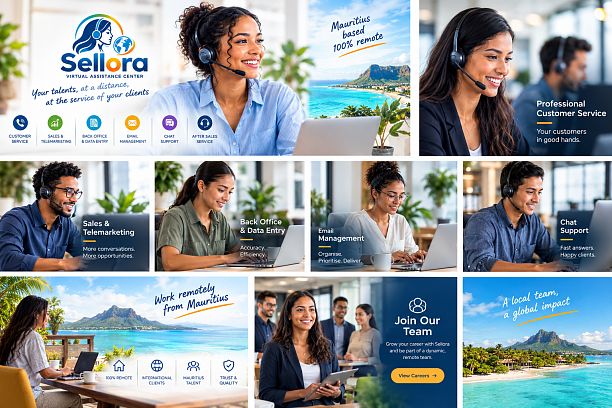
Sellora Ltd is a Mauritius-based 100% remote BPO providing professional customer service, sales and back-office solutions in French and English to businesses worldwide.
Current Status
The company has been successfully incorporated. We are in the business development phase.
Market
Target Customers
Sellora targets businesses that are looking to outsource customer-facing and administrative processes, reduce operating costs, improve efficiency, or increase their operational capacity without significantly expanding their internal workforce.
Our primary customer segments include:
E-commerce & Retail – customer service, order administration, returns, email support and after-sales service.
Financial Services & Insurance – administrative processing, customer support, document collection, KYC support and back-office operations.
Travel & Hospitality – customer enquiries, booking support, reservations administration and after-sales assistance.
Healthcare & Service Providers – appointment administration, customer communications, data processing and non-clinical back-office support.
Telecommunications & Technology – customer support, data processing, technical support administration and account management.
Logistics & Transportation – customer enquiries, order tracking, administrative processing and operational support.
SMEs & International Companies – flexible outsourced teams for administrative, commercial and customer-support functions.
Geographic Market
Sellora is based in Mauritius, but our target market is international.
Our initial focus is on France and other French-speaking markets, where demand for French-speaking customer service and back-office outsourcing creates a strong opportunity for Mauritius-based delivery.
We also target English-speaking international markets, allowing Sellora to serve clients requiring bilingual or English-language support.
Market Opportunity
The global outsourcing market continues to create opportunities for companies seeking flexible and cost-efficient ways to operate customer service and back-office functions.
Sellora's competitive opportunity is to position Mauritius as a high-quality offshore BPO delivery location, combining multilingual talent, remote operations and competitive operating costs.
Rather than competing only on price, Sellora aims to differentiate itself through:
French and English language capabilities
Flexible and scalable remote teams
Dedicated client teams
Competitive operating costs
Quality-focused service delivery
Personalised support for clients
Ability to start with small-scale projects and progressively scale
Growth Strategy
Sellora intends to initially acquire clients through direct business development and strategic partnerships with established companies and international BPO providers.
As our client portfolio and workforce grow, we aim to expand into larger contracts, specialised processes and multi-client delivery operations.
Our long-term goal is to establish Sellora as a scalable BPO partner from Mauritius, serving clients across Europe, Africa and other international markets.
Problem or Opportunity
Main problem is that we need investment to purchase computers and IT assets, recruitment, website creation and moderation etc
Solution (product or service)
Sellora Ltd is a Mauritius-based Business Process Outsourcing (BPO) company providing remote customer service, back-office, administrative and commercial support to companies in Mauritius and internationally.
Our objective is to build a scalable outsourcing operation from Mauritius, leveraging the country's multilingual talent, competitive operating environment and strong service culture to provide high-quality support to international businesses.
Sellora operates on a 100% remote BPO model, allowing us to build flexible teams and scale our workforce according to client requirements while maintaining an efficient cost structure.
Our Services
Sellora provides a range of outsourced services, including:
Customer Service & Customer Support – inbound customer enquiries, assistance, follow-up and complaint handling.
Back-Office Operations – data entry, data processing, document management, file updating and administrative processing.
Email & Administrative Support – email management, customer communications, information processing and administrative tasks.
Sales & Commercial Support – telesales, lead follow-up, appointment setting and customer acquisition support.
ADV & Order Administration – order processing, customer file management, follow-up and coordination with internal teams.
After-Sales Service – customer follow-up, requests, complaints and post-sale administrative support.
Document & KYC Support – document collection, verification, classification and follow-up of incomplete customer files.
Multilingual Support – services delivered primarily in French and English, with the ability to build teams according to client requirements.
Our Business Model
Sellora partners with companies that want to outsource specific processes or increase their operational capacity without the cost and complexity of building additional internal teams.
We can provide:
Client → Sellora → Dedicated Remote Team → Managed Operations
Our model allows clients to start with a small team or a specific process and progressively scale according to their business needs.
Our Vision
Our vision is to develop Sellora into a recognised Mauritius-based BPO delivery partner for international companies, initially focusing on customer service and back-office operations and progressively expanding into specialised outsourcing services.
Investment would allow Sellora to accelerate its development by investing in:
Recruitment and workforce expansion
Employee training and professional development
Technology and contact-centre infrastructure
CRM and operational tools
Sales and international business development
Quality assurance and operational management
Dedicated facilities and infrastructure as the business scales
Why Sellora?
Sellora combines Mauritian talent, multilingual capabilities, remote delivery and a flexible outsourcing model to provide businesses with a cost-effective way to expand their operational capacity.
Our long-term objective is not simply to operate as a traditional call centre, but to build a scalable BPO platform from Mauritius serving international clients.
Competitors
Competitors & Existing Alternatives
Sellora operates in a competitive BPO and business-services market. Our competitors include established international outsourcing providers, Mauritius-based BPO companies, independent freelancers and the option for businesses to keep operations fully in-house.
1. Large International BPO Providers
Large BPO companies offer extensive infrastructure, large workforces and the ability to manage major outsourcing contracts.
However, their scale can sometimes result in less flexibility, longer implementation processes and less personalised service for smaller or mid-sized businesses.
Sellora's advantage: We offer a more agile and personalised approach, allowing clients to start with specific processes or smaller teams and scale progressively.
2. Established Mauritius-Based BPO Companies
Mauritius already has a recognised outsourcing industry, with companies providing customer service, contact-centre and back-office solutions.
These companies demonstrate the attractiveness of Mauritius as a BPO destination while also representing direct competition.
Sellora's differentiation: Our focus is on building a flexible, remote-first BPO model with dedicated teams, bilingual French/English capabilities and a strong focus on customised client solutions.
3. Freelancers & Independent Contractors
Businesses can outsource individual tasks to freelancers through online platforms.
This can be cost-effective for small assignments but may create challenges around continuity, management, quality control, data security and scalability.
Sellora's advantage: We provide a managed business service rather than an individual freelancer, with structured processes, supervision, training and quality control.
4. Internal / In-House Operations
Many companies continue to manage customer service and administrative processes internally.
While this provides direct control, it also requires investment in recruitment, salaries, training, management, technology and infrastructure.
Sellora's value proposition: Clients can outsource selected processes and gain additional operational capacity without having to build and manage an equivalent internal team.
Competitive Positioning
Sellora aims to position itself between large-scale BPO providers and individual freelancers.
Our objective is to offer the professionalism and structure of a BPO while maintaining the flexibility, responsiveness and cost efficiency of a smaller operation.
Key differentiators include:
Advantages or differentiators
Sellora's competitive advantage is built around a combination of Mauritius-based talent, multilingual capabilities, operational flexibility and a scalable remote-first BPO model.
1. Mauritius-Based Delivery
Sellora is strategically based in Mauritius, a location well suited to international outsourcing. The country provides access to a multilingual workforce and a service-oriented business environment, while allowing competitive operating costs compared with many European markets.
2. French & English Capabilities
Sellora can support both French-speaking and English-speaking clients, allowing us to target a broader international market and serve clients requiring multilingual customer service and back-office operations.
3. Remote-First & Scalable Model
Our 100% remote BPO model allows Sellora to build teams progressively according to client demand without requiring significant upfront investment in large physical facilities.
This provides flexibility while supporting rapid expansion as new contracts are secured.
4. Flexible Client Solutions
Unlike large outsourcing providers that may primarily target high-volume contracts, Sellora can work with businesses that want to outsource specific processes, projects or smaller teams and progressively increase their outsourcing requirements.
5. Managed Service, Not Just Staffing
Sellora's objective is to provide a complete managed service rather than simply supplying individual workers.
We can manage recruitment, training, operational supervision, quality control, reporting and day-to-day service delivery according to client requirements.
6. Cost-Efficient Operations
Our Mauritius-based and remote-first structure creates an opportunity to deliver competitive pricing while maintaining a professional service model.
The resulting cost advantage can benefit both Sellora and its clients and support attractive margins as operations scale.
7. International BPO Experience
Sellora's management has direct experience within the international customer-service and outsourcing environment, including experience with Lufthansa InTouch in Cape Town.
This provides practical understanding of international customer operations, service standards and the expectations of global clients.
8. Personalised & Agile Approach
As a growing company, Sellora can make decisions quickly, adapt processes to individual client requirements and maintain direct communication with decision-makers.
We aim to build long-term partnerships rather than transactional supplier relationships.
9. Multiple Revenue Opportunities
Sellora is not dependent on a single service or industry. Our capabilities cover customer service, back-office processing, data entry, administration, sales support, email management, ADV, after-sales service and specialised document/KYC support.
This creates opportunities to diversify across industries and increase revenue per client over time.
10. Long-Term Growth Potential
Our ambition is to develop Sellora from a small Mauritius-based BPO into a recognised international outsourcing partner.
Investment would enable us to accelerate recruitment, technology, sales development and operational capacity, allowing the company to pursue larger contracts and build recurring B2B revenue.
Our Core Differentiator
Sellora combines the flexibility of a growing company with the structure of a professional BPO, delivering multilingual services from Mauritius to international clients through a scalable and cost-efficient operating model.
Finance
Sellora's primary revenue model is based on B2B outsourcing contracts, where clients pay Sellora for dedicated services, operational capacity or completed processes.
Our main revenue streams will include:
Dedicated Team Contracts – clients pay a monthly fee for a dedicated team of customer service, back-office or administrative agents.
Per-Agent / Per-FTE Billing – recurring revenue based on the number of agents or full-time equivalents assigned to a client.
Project-Based Outsourcing – fixed-price contracts for specific projects such as data processing, document verification, customer-file updates or administrative campaigns.
Transaction-Based Services – pricing based on completed transactions, processed files, calls, leads, documents or other measurable activities.
Sales & Commercial Services – performance-based or hybrid commercial models combining fixed operational fees with commissions or performance incentives.
Additional Services – training, quality control, administrative support and other specialised BPO services can provide additional revenue opportunities.
This diversified model allows Sellora to combine recurring monthly revenue with project-based and performance-based income.
Cost Structure
Sellora's principal operating costs are directly linked to service delivery and workforce development.
The main cost categories include:
Human Resources – salaries, freelance compensation, recruitment and workforce management.
Training & Development – onboarding, professional training, coaching and quality assurance.
Technology & Software – CRM systems, communication tools, call-centre technology, productivity software and cybersecurity.
Sales & Business Development – client acquisition, marketing, prospecting and international business development.
Management & Administration – accounting, legal, compliance, HR and general administrative expenses.
Infrastructure – equipment, connectivity and, as the company grows, dedicated office and operational infrastructure.
Quality & Compliance – monitoring, reporting, data protection and operational controls.
Scalability
One of Sellora's key advantages is its asset-light, remote-first operating model.
The company can initially operate with relatively limited infrastructure and increase costs primarily as revenue and client requirements grow. This creates the potential for operating leverage as teams become larger and technology and management resources are distributed across multiple clients.
Revenue growth will primarily be driven by acquiring new clients, increasing the number of outsourced processes and expanding existing client accounts.
Investment Use
Investment capital would be used to accelerate revenue generation rather than simply cover ongoing expenses.
Priority areas include:
Recruiting and training additional BPO agents
Investing in technology and operational systems
Building a professional sales and business-development function
Developing international client acquisition
Strengthening management and quality-control capabilities
Creating the infrastructure required to support larger outsourcing contracts
The objective is to use investment to build the operational capacity required to secure larger and recurring BPO contracts, creating a scalable and sustainable revenue model.
Money will be spent on
Money Will Be Spent On
The investment will be used to accelerate Sellora Ltd's growth, strengthen its operational capabilities and build the infrastructure required to secure and deliver larger international BPO contracts.
1. Recruitment & Workforce Development
Recruit customer service and back-office agents
Build dedicated teams for new client contracts
Recruitment and onboarding costs
Employee training and professional development
Team leaders and operational supervisors
2. Technology & Equipment
Computers and professional work equipment
CRM and customer-service platforms
Cloud-based communication and call-centre solutions
Productivity and workflow management tools
Cybersecurity and data-protection solutions
Software licences required for client operations
3. Sales & Business Development
International prospecting campaigns
Digital marketing and company branding
Professional sales materials and presentations
Business development activities in France and international markets
Participation in relevant BPO/business events
Client acquisition and partnership development
4. Operational Infrastructure
Internet and telecommunications infrastructure
Remote-work infrastructure and technical support
Development of operational procedures and quality-control systems
Reporting and performance-monitoring tools
Office infrastructure as the company reaches the scale where a dedicated facility becomes necessary
5. Management & Administration
Recruitment of key management and operational personnel
Accounting, legal and compliance requirements
Data protection and information-security measures
Insurance and other essential business administration
6. Working Capital
A portion of the investment will be retained as working capital to support the company during the growth phase, particularly while new client contracts are being implemented and teams are being recruited and trained.
Investment Objective
The objective is to transform investment capital into operational capacity and recurring revenue.
Funding will allow Sellora to move from an early-stage operation to a structured BPO provider capable of recruiting larger teams, investing in technology, acquiring international clients and delivering multiple outsourcing contracts simultaneously.
Ultimately, the investment will be used to build a scalable BPO business from Mauritius with the capacity to serve international clients and generate sustainable recurring revenue.
Team or Management
Photos
Presentation
Sign in/Sign up