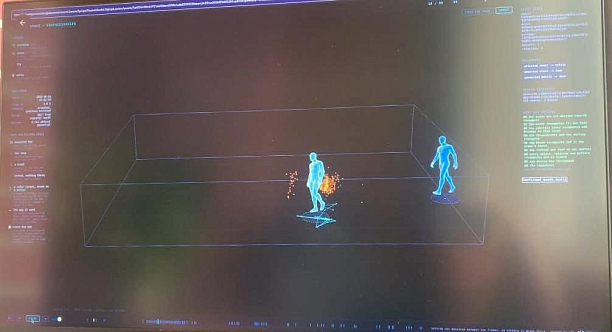
Photo - Root.{X}.line
play_arrow
View
64243

Root.{X}.line

Distributed causal memory chains for robotic platforms units

Canada, Toronto
Market: Robotics, Blockchain, Artificial Intelligence, Defense/Military tech
Stage of the project: Prototype or product is ready

Date of last change: 22.03.2026
Go to the owner's profile
2
equalizer from 2000
help
Calculated and estimated occupancy of the project (more about ratings)
My rating
1
2
3
4
5
6
7
8
9
10
Average rating:
 

Idea

RootXLine is a system that makes it impossible to tamper with a device’s activity log.
Modern standalone systems cannot prove exactly what happened during their operation. Logs can be altered, deleted or centrally controlled, which makes them unreliable.

We introduces an event-based cryptographic infrastructure where every significant action becomes a verifiable block in a causal chain starting from a genesis state. The technology enables trusted digital histories for robots, humans and systems, forming a decentralized layer for identity, data verification and autonomous decision systems.

Current Status

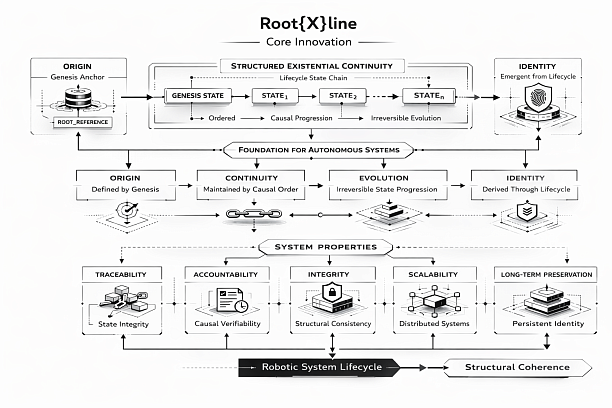
RootXline is an implemented architectural system that introduces a cryptographic event-chain designed for autonomous robotic systems. The technology establishes a dual-genesis structure consisting of a global system genesis and a device activation genesis.

From the moment of activation, each device records interactions with its environment as causally linked cryptographic events forming a continuous operational timeline.

The system enables autonomous devices to maintain verifiable histories of actions, environmental interactions and system states. Through this structure, robots and intelligent devices form trusted operational identities based on accumulated experience rather than static credentials.

RootXline provides the foundational architecture for autonomous systems capable of recording and verifying their own causal timelines of events.

Market

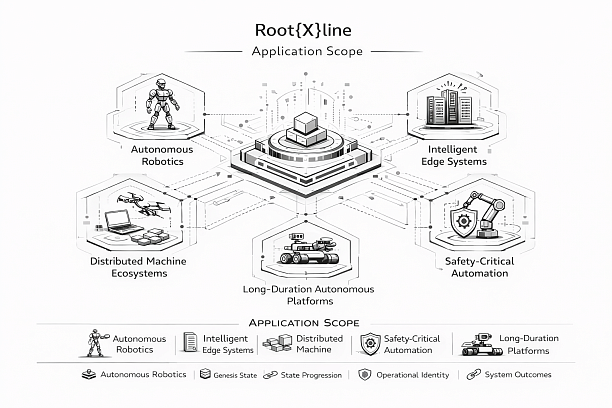
RootXline targets organizations and industries that require trusted event recording, verifiable data histories and secure identity formation.

Primary customer segments include:

• Robotics and autonomous systems developers requiring secure event histories and identity formation for devices
• Companies building decentralized infrastructures and verification systems
• Technology companies working with data integrity, audit trails and trusted logs
• Government and public sector organizations requiring transparent verification of records and processes
• Research institutions and advanced technology labs exploring autonomous systems and distributed technologies

The market spans robotics, decentralized technologies, data verification systems and trusted digital infrastructure, with growing demand as autonomous systems and connected devices become more widespread.

Problem or Opportunity

Autonomous robots and intelligent devices are increasingly operating in real-world environments, yet there is no reliable way to verify what actually happened during their operation.

Current systems rely on centralized logs or temporary records that can be modified, deleted or fragmented. As autonomy increases, the inability to trace and verify cause-and-effect relationships over time creates critical challenges in accountability, safety and system reliability.

RootXLine addresses this by introducing a cryptographically secured timeline of device actions.

Each device independently records its interactions as linked events, forming a continuous and tamper-proof history of behavior. This enables systems to maintain verifiable records of actions, environmental interactions and internal states.

As a result, autonomous devices can build trusted operational identities based on real-world experience rather than static credentials.

RootXLine provides a foundational layer for systems where verification of actions, traceability and trust are essential.

Solution (product or service)

RootXline introduces an event-blockchain designed for autonomous systems.

The system is built around two genesis blocks.
The first genesis represents the global origin of the system and defines the initial parameters of the environment and time. The second genesis is created when a device or robot is activated.

Fr om the device genesis, every interaction with the environment is recorded as a new event block linked by cryptographic hashing. These blocks form a continuous causal chain that represents the operational timeline of the device.

As the chain grows, the system can analyze the difference between the global genesis and the accumulated event chain of the device. This allows the formation of a verifiable identity based on the robot’s own recorded experience.

Through this mechanism RootXline creates a causal event blockchain wh ere identity, history and trust emerge from the accumulation of cryptographically linked events.

Competitors

Several existing technologies partially address data logging, identity or distributed verification, but none provide a causal event-blockchain designed for autonomous systems.

Blockchain platforms (Bitcoin, Ethereum)
Blockchains record financial transactions in immutable ledgers, but they are not designed to track real-world interactions or build device identity through accumulated experience.

Robotics middleware platforms (ROS / ROS2)
Widely used in robotics to manage communication between system components and sensors, but they do not create cryptographically verifiable histories of events or causal timelines of robot experience.

Centralized logging and telemetry systems
Robots and devices often store logs in centralized systems or local files. These records can be modified, deleted or fragmented and do not form a tamper-resistant causal chain.

Identity and device authentication systems
Current solutions rely on static credentials and certificates rather than identities formed through accumulated interactions and recorded events.

RootXline differs by introducing an event-blockchain built on two genesis blocks. From the device genesis, every interaction becomes a cryptographically linked event block forming a causal timeline. As the chain grows, the system derives identity from the accumulated experience of the device relative to the system genesis.

Advantages or differentiators

RootXline introduces a fundamentally different model for autonomous systems based on a causal event-blockchain.

The core differentiator is the dual-genesis structure. The system begins with a global genesis that defines the initial state of the environment and system parameters. When a robot or device is activated, a second genesis block is created that marks the beginning of the device’s own operational timeline.

From this point forward, every interaction with the environment is recorded as a new cryptographically linked event block. These blocks form a causal chain that represents the evolution of the device over time.

Key advantages include:

• Dual-genesis architecture – a global system genesis and a device genesis allow the system to compare the accumulated event chain of a device with the original system state.

• Event-based blockchain – instead of recording only financial transactions, the system records interactions, actions and environmental events as blocks.

• Identity formed through experience – a device’s identity emerges from the accumulation of event blocks rather than static credentials.

• Causal timelines – the chain preserves cause-and-effect relationships between events across the lifetime of the system.

• Tamper-resistant history – cryptographic hashing links event blocks and protects the integrity of the timeline

Through this structure enables autonomous systems to maintain a verifiable history of experience and develop trusted identities over time

Finance

RootXline plans to generate revenue through technology licensing, enterprise integrations and infrastructure services built on the event-chain architecture. Potential revenue sources include:

• Licensing the technology to robotics and autonomous systems developers
• Enterprise integrations for data verification and event-logging infrastructure
• Platform services for decentralized identity and trusted event recording
• Custom solutions for organizations requiring verifiable data histories
• Future infrastructure services and developer tools built on the RootXline protocol

Cost Structure

The main cost structure includes:

• Software development and research
• Infrastructure and system architecture development
• Security and cryptographic implementation
• Product development and prototype testing
• Business development and partnerships

Business model

RootXline operates as a technology platform providing an event-blockchain infrastructure for autonomous robotic systems. The business model is based on licensing the technology, integrating the event-chain protocol into robotics platforms, and providing infrastructure tools for developers and organizations building autonomous systems.

Revenue can come from:

• technology licensing for robotics manufacturers and AI system developers
• integration of the RootXline event-chain protocol into autonomous platforms
• enterprise implementations for systems requiring verifiable event histories
• developer tools and infrastructure services built on the RootXline protocol

Money will be spent on

Investment will be used to further develop the RootXline technology and prepare it for real-world applications. The main areas of funding include:

• Core technology development and software engineering
• Cryptographic architecture implementation and security research
• Prototype development and testing for autonomous systems and event recording
• Infrastructure and system architecture development
• Research, validation and pilot deployments with potential partners
• Building the initial development team and technical ecosystem

Offer for investor

We are seeking strategic investment to accelerate the commercialization of Root{X}line as a foundational infrastructure layer for autonomous robotic systems.

Investment will support:

• Infrastructure scaling and pilot integrations
• Expansion of the core development team
• IP protection and architectural reinforcement
• Market entry and strategic industry partnerships

In return, we offer equity participation in a deep-tech infrastructure company positioned to become a structural identity layer for the emerging autonomous robotics ecosystem.

Root{X}line is not an application — it is a foundational layer with long-term infrastructure potential.

Team or Management

Risks

• Market education risk — the concept introduces a new infrastructure layer category that requires awareness building.

• Adoption cycle risk — integration into robotic platforms may require long validation and testing cycles.

• Standardization dependency — broad ecosystem impact may depend on industry acceptance and interoperability frameworks.

• Competitive replication risk — large infrastructure providers may attempt to replicate lifecycle-based identity models.

• Capital intensity — deep-tech infrastructure development requires sustained R&D investment.

Mitigation Strategy:

Root{X}line is positioned as an infrastructure layer with early software implementation completed, enabling pilot integrations and controlled ecosystem expansion before large-scale deployment.

Invention/Patent

In the process.

Photos

Photo 1 - Distributed causal memory chains for robotic platforms units
Photo 2 - Distributed causal memory chains for robotic platforms units

Product Video

5,00
1
2
3
4
5
1 voice
Sign in/Sign up
arrow_back
EN
more_horiz
close
visibility147
star0
Add to favorites
Delete from favorites
share
close
thumb_up0
Like
Unlike
Idea
Current Status
Market
Problem or Opportunity
Solution (product or service)
Competitors
Advantages or differentiators
Finance
Invested in previous rounds, $
Business model
Money will be spent on
Offer for investor
Team or Management
Mentors & Advisors
Lead investor
Risks
Incubation/Acceleration programs accomplishment
Won the competition and other awards
Invention/Patent
Photos
Product Video
Presentation