Photo - Agbos digital spark
64184

Agbos digital spark

Digital Ajo savings and instant payments for Nigerians.

Nigeria
Market: Financial services
Stage of the project: Prototype or product is ready

Date of last change: 10.12.2025
Go to the owner's profile
0
equalizer from 2000
help
Calculated and estimated occupancy of the project (more about ratings)
My rating
1
2
3
4
5
6
7
8
9
10
Average rating:
 

Idea

AJOPAY is a digital Ajo/Esusu platform that automates group savings, contributions, and payouts while enabling users to send money instantly to any Nigerian bank through Sterling Bank integration. It replaces manual Ajo with secure, transparent, and modern financial tools built for communities, traders, cooperatives, and everyday Nigerians.

Current Status

AJOPAY is already fully developed for both Android and iOS, with backend infrastructure and bank integration completed. The product is not yet launched publicly because we are preparing for App Store deployment and initial marketing. We currently have no paying users yet, but we have a waiting list and community interest, and the platform is technically ready for launch once funding for deployment and scaling is secured.

Market

Target Customers:
AJOPAY serves individuals and groups in Nigeria who participate in traditional savings systems such as Ajo/Esusu or cooperative savings. This includes market traders, small business owners, cooperative members, and community groups.

Age Group:
Primarily adults aged 18–40 who are digitally savvy, with some participation fr om adults aged 40–60 who take part in savings groups.

Customer Characteristics:
• Regular contributors in cash-based savings groups.
• Prefer community-based savings over formal banks due to trust.
• Seek a digital, transparent, and convenient way to manage contributions and payouts.
• Smartphone users or mobile-account holders willing to transition from manual savings to digital solutions.

Location:
Nationwide across Nigeria, especially urban and semi-urban areas with high population density, active trade, and vibrant informal economy.


Market Size and Opportunity

Local Market (Nigeria):
• Millions of Nigerians participate in informal savings and cooperative groups.
• Surveys show a high willingness to adopt digital solutions for safer, more transparent savings.
• Smartphone adoption and digital finance usage are growing, creating a strong opportunity for AJOPAY.
• Targeting even a small fraction of participants (2–5 million users) represents a substantial market.

Regional / Global Context:
• In West Africa, community-based savings and rotating funds are widespread.
• Digital savings platforms are emerging, driven by smartphone adoption and financial inclusion initiatives.
• Demand for secure, transparent digital savings is rising as users move from cash-based methods to mobile and online platforms.

Market Development:
• The informal savings market in Nigeria is growing, driven by cultural acceptance, smartphone penetration, and digital finance trends.
• Increasing adoption of fintech solutions indicates strong potential for long-term growth.


Market Potential for AJOPAY
• Nigeria has over 120 million adults. Even if 5–10% participate in rotating savings and have smartphone access, that’s 6–12 million potential users.
• Capturing 1–2% initially could mean 60,000–240,000 users.
• With a transaction-fee business model and recurring contributions, the platform can generate substantial revenue.
• Growth potential is amplified by network effects, as groups recruit more members.

Why This Market Is Attractive:
• Existing demand: millions already participate in Ajo/Esusu.
• Cultural acceptance: savings circles are widely trusted and understood.
• Under-served by formal banking: AJOPAY provides convenience and security wh ere banks do not reach.
• Low competition in digital Ajo + bank transfer solutions.
• Positive economic and fintech trends increase adoption potential.


Risks to Monitor
• User trust: transitioning from cash-based to digital requires strong proof of security.
• Smartphone/internet access: some potential users may have limited access.
• Regulatory compliance: banking integrations require adherence to KYC/AML rules.
• Competition: other fintechs or banks may introduce similar solutions.

Problem or Opportunity

AJOPAY targets individuals and groups in Nigeria who participate in Ajo/Esusu (rotating savings) and cooperative savings schemes. This includes market traders, community groups, SMEs, and everyday Nigerians who rely on informal savings to manage finances, build capital, or meet short-term financial goals.

Problem:
Traditional Ajo/Esusu systems are manual, opaque, and risky:
• Contributions are tracked on paper or WhatsApp groups, prone to errors and fraud.
• Members often lose money due to mismanagement or lack of transparency.
• Collecting, pooling, and distributing funds is time-consuming and inconvenient.
• Participants cannot easily access or transfer their savings digitally.

Evidence / Validation:
• Millions of Nigerians participate in informal savings groups monthly, indicating a large, active market.
• Current methods rely on trust rather than secure systems, creating a real financial risk.
• Surveys and anecdotal reports from markets and communities show people are willing to pay small fees for safer, automated systems that protect their contributions.

Solution / Why Clients Will Pay:
AJOPAY digitizes Ajo/Esusu and integrates directly with Sterling Bank to:
• Track contributions automatically.
• Schedule payouts transparently.
• Enable instant transfers to any bank account.
• Reduce risk of lost funds or mismanagement.

Clients are ready to pay small transaction fees because it guarantees security, transparency, and convenience that traditional methods cannot provide. The demand is driven by the size of the informal savings market, cultural acceptance of Ajo/Esusu, and rising smartphone adoption.

Opportunity:
• Over 50 million Nigerians are estimated to participate in Ajo/Esusu.
• Informal savings market exceeds hundreds of billions of naira annually, largely offline.
• Digital adoption is growing; AJOPAY converts a trusted offline practice into a safe, scalable, digital platform, making it an attractive market for investors.

Solution (product or service)

Product Name: AJOPAY

What it is:
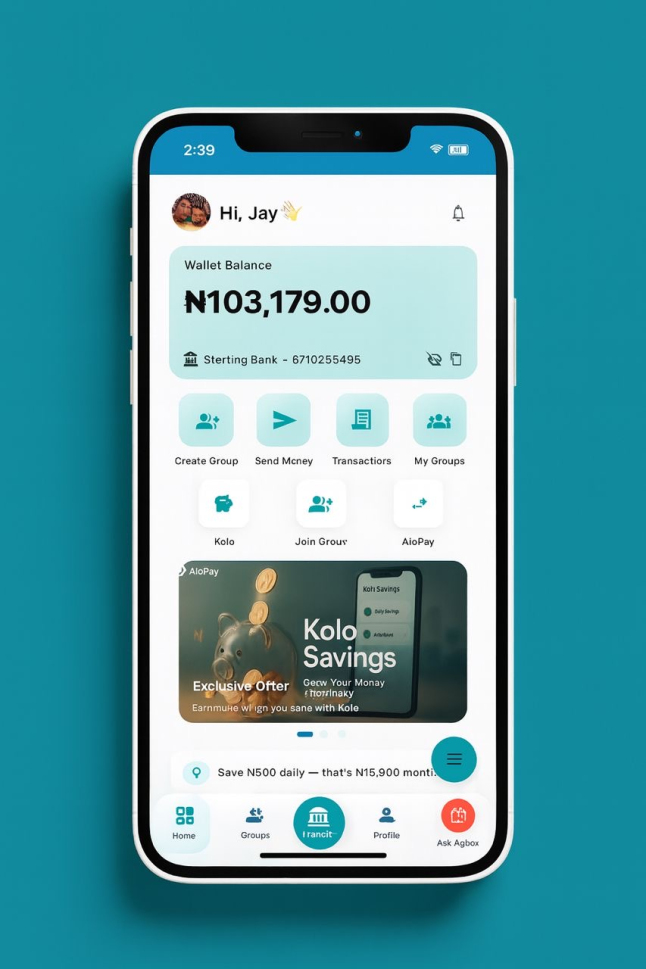
AJOPAY is a digital Ajo/Esusu platform designed to help individuals and groups manage rotating savings, contributions, and payouts in a secure, transparent, and automated way. The platform is available as a mobile app for both Android and iOS and integrates directly with Sterling Bank for seamless and secure transactions.

How it works:
• Users can create or join Ajo/Esusu groups.
• Contributions are automatically tracked within the app.
• Scheduled payouts are automated and can be transferred to any bank account instantly.
• The platform provides real-time dashboards so group members can monitor contributions, payouts, and balances.
• Users receive notifications for contributions, due dates, and payouts, reducing missed payments or disputes.

Problems it solves:
• Eliminates manual record-keeping errors.
• Reduces fraud and mismanagement risks in informal savings groups.
• Makes it easy to transfer contributions digitally, avoiding cash handling.
• Increases trust and transparency among group members.
• Allows anyone with a smartphone to participate in organized savings.

Market advantage / Why clients pay:
• Millions of Nigerians participate in Ajo/Esusu, but most groups operate offline or via informal methods.
• Clients are willing to pay small transaction fees for security, convenience, and transparency.
• AJOPAY converts a traditional savings culture into a scalable, digital solution, making it both attractive and necessary.

Visuals (optional for submission):
• Screenshots of Android & iOS apps
• Sample dashboard of contributions and payouts
• Flow diagram of Sterling Bank integration for secure transfers

Competitors

Direct Competitors:
Currently, there are very few direct competitors offering a fully digital Ajo/Esusu platform with bank integration in Nigeria. Some fintech apps and cooperative savings apps exist, but they do not combine traditional rotating savings systems with instant bank transfers and full transparency like AJOPAY. As such, AJOPAY occupies a unique niche.

Indirect Competitors / Alternatives:
Most users currently rely on:
• Manual Ajo/Esusu systems — cash-based contributions tracked on paper or verbally.
• WhatsApp or Excel-based tracking — informal digital tracking without financial integration.
• Traditional banks or mobile money platforms — some users transfer money digitally, but these systems do not replicate the cultural rotating savings model or provide group management tools.

Market Share:
• Given the limited number of digital platforms fully addressing Ajo/Esusu needs, AJOPAY’s direct digital competitors hold a small fraction of the potential market.
• The informal manual systems dominate in terms of usage (~90–95% of groups), highlighting the large opportunity for digitization.

Conclusion:
AJOPAY differentiates itself by combining cultural familiarity with modern fintech capabilities, creating a more secure, transparent, and scalable solution that current alternatives cannot match.

Advantages or differentiators

Indisputable Advantages:
AJOPAY offers several advantages that are difficult for competitors to copy quickly:
1. Cultural Integration: The platform is specifically designed for Ajo/Esusu, a deeply-rooted Nigerian savings tradition, which gives AJOPAY a strong product-market fit.
2. Bank Integration: Direct integration with Sterling Bank allows secure, instant transfers to any Nigerian bank account while ensuring AJOPAY does not hold customer funds — a critical trust factor.
3. Automated Group Management: AJOPAY automates contribution tracking, payout scheduling, and notifications, reducing human error and fraud risk in traditional systems.
4. Transparency and Trust: Every transaction is traceable within the app, creating an unprecedented level of transparency in informal savings groups.

Differentiators:
• User-friendly dashboards for group members and administrators.
• Notifications and reminders for contributions and payouts.
• Scalable platform able to support hundreds of thousands of groups simultaneously.
• Potential for premium features (analytics, reporting, enhanced group tools) to add value beyond basic contributions.

Conclusion:
AJOPAY is not just a fintech app; it digitizes a culturally entrenched system while ensuring security, transparency, and scalability — differentiators that current competitors lack or cannot easily replicate.

Finance

Financial Model and Revenue Projections

Pricing / Revenue Model:
AJOPAY generates revenue primarily through small transaction fees on every contribution or payout processed through the platform.
• Transaction fee: 1–2% per transfer (typical for fintech platforms in Nigeria).
• Additional potential revenue streams: premium group tools, corporate/organizational partnerships, and optional value-added services for groups.

Revenue Assumptions:
• Average user contributes ~₦5,000–₦10,000 per month via AJOPAY groups.
• With 1–2% transaction fee, each active user generates approximately ₦50–₦200 per month in revenue.
• User growth is projected based on conservative adoption rates within Nigeria’s informal savings market.

5-Year Sales Expectations (Approximate):
Year
Active Users
Revenue per Month (₦)
Revenue per Year (₦)
1
50,000
5,000,000
60,000,000
2
150,000
15,000,000
180,000,000
3
300,000
30,000,000
360,000,000
4
500,000
50,000,000
600,000,000
5
1,000,000
100,000,000
1,200,000,000

Notes:
• Growth assumes expansion through community adoption, referrals, and marketing.
• Revenue per user may increase as additional features or premium services are introduced.
• These are approximate projections based on the informal savings market and average group contributions.

Key Financial Indicators (Approximate / Target):
• Gross Transaction Volume (GTV): ~₦600 million in Year 1, scaling to over ₦12 billion by Year 5.
• Monthly Active Users (MAU): starts at ~50,000 in Year 1, reaching ~1,000,000 by Year 5.
• Revenue Growth Rate: ~200–250% annual growth in early years, tapering as user base matures.
• Break-even Point: Expected in Year 2–3, as user adoption increases and operational costs stabilize.

Summary:
AJOPAY’s revenue model is transaction-based, scalable, and predictable, with potential to expand through premium services and partnerships, making it an attractive investment for early-stage funding.
Business model

Business Model

AJOPAY operates on a transaction-based revenue model. Every contribution or payout processed through the platform incurs a small fee (1–2%), ensuring predictable, recurring revenue.

The platform also plans to generate additional income through:
• Premium group features (advanced tracking, reporting, or management tools)
• Corporate partnerships with cooperatives or community organizations
• Value-added services such as automated notifications, analytics, or integration with third-party financial services

By digitizing traditional Ajo/Esusu and integrating with Sterling Bank for secure payments, AJOPAY creates value for users through trust, transparency, and convenience, while capturing a portion of the transaction volume for revenue.

The model is scalable, as more groups and users join, revenue grows proportionally to the volume of contributions processed, without significant incremental costs.

Money will be spent on

The investment in AJOPAY will be used primarily to launch, scale, and expand the platform across Nigeria. The main areas of expenditure include:

1. App Store Launch and Platform Scaling:
• Publishing the iOS app on the App Store and ensuring full compliance with Apple’s requirements.
• Expanding server infrastructure to handle a growing number of users and transactions securely.

2. Marketing and User Acquisition:
• Nationwide campaigns to attract users, including digital marketing, community outreach, partnerships with cooperatives, and referral programs.
• Educational campaigns to build trust and encourage adoption among groups currently using manual savings systems.

3. Product Development and Maintenance:
• Ongoing development for app improvements, new features, and premium tools.
• Regular maintenance, bug fixes, and updates to ensure a secure and reliable platform.

4. Operations and Compliance:
• Regulatory compliance, including KYC/AML processes and banking integrations.
• Administrative costs, customer support, and operational staff.

5. Contingency and Growth:
• Reserve funds to manage unforeseen challenges, accelerate expansion, and scale efficiently as the user base grows.

Summary:
The investment will ensure AJOPAY is secure, fully functional, and widely adopted, creating a strong foundation for growth, revenue generation, and long-term sustainability.

Offer for investor

At this stage, AJOPAY is open to negotiations with investors to determine a fair equity share based on the investment amount, strategic value, and growth potential.

In general, we are considering offering 10–25% equity for early-stage investment, depending on the size of the funding and the involvement of the investor in scaling the platform.

During discussions, we emphasize that the goal is to align incentives, ensuring investors benefit from AJOPAY’s growth while retaining enough equity for the founding team to continue driving the business forward.

Team or Management

Risks

While AJOPAY has strong potential, there are several risks that could impact the business:

1. User Trust & Adoption:
• Transitioning from traditional cash-based Ajo/Esusu to a digital platform requires building trust. Users may hesitate to rely on an app for financial contributions until the platform proves secure and reliable.

2. Regulatory & Compliance Risks:
• Integration with banks and handling financial transactions require adherence to KYC/AML regulations and fintech compliance standards. Changes in regulations could affect operations.

3. Competition:
• Existing or new fintechs may introduce similar solutions, potentially reducing market share. Large banks or established digital wallets could adapt and compete directly.

4. Technology & Security Risks:
• Technical issues, platform downtime, or security breaches could harm user confidence and trust. Continuous investment in secure infrastructure is essential.

5. Market & Economic Risks:
• Economic downturns, reduced disposable income, or changes in informal savings practices could impact user adoption and contribution volumes.

6. Cultural & Behavioral Risks:
• Ajo/Esusu is deeply cultural; some communities may prefer traditional methods despite digital alternatives. Adoption may be slower in certain regions or demographics.

Conclusion:
AJOPAY’s success depends on gaining user trust, maintaining secure and compliant operations, adapting to market changes, and differentiating from competitors. Awareness and proactive management of these risks are integral to long-term sustainability.
5,00
1
2
3
4
5
1 voice
Sign in/Sign up
arrow_back
EN
more_horiz
close
visibility12
star0
Add to favorites
Delete from favorites
share
close
thumb_up0
Like
Unlike
Idea
Current Status
Market
Problem or Opportunity
Solution (product or service)
Competitors
Advantages or differentiators
Finance
Invested in previous rounds, $
Business model
Money will be spent on
Offer for investor
Team or Management
Mentors & Advisors
Lead investor
Risks
Incubation/Acceleration programs accomplishment
Won the competition and other awards
Invention/Patent
Photos
Product Video
Presentation