Ukraine, Kiev region
Market: Power Engineering
Project stage: Prototype or product is ready
Also this project:
- Find investments
Idea or High Level Concept
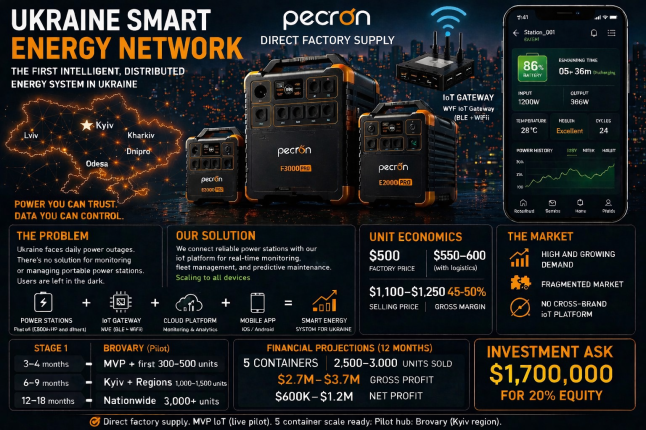
We are building a distributed energy network in Ukraine based on portable power stations connected to an IoT platform.
We import stations directly from manufacturers at low cost and integrate them into a unified system for real-time monitoring, centralized control, and predictive maintenance.
The solution targets businesses, government institutions, and NGOs that require reliable power during ongoing energy instability.
The project starts with a pilot in Brovary and scales to 3,000+ units across Ukraine
Territory of the product or service implementation
Ukraine
Traction and Current Status
MVP IoT system developed (BLE data decoding and live monitoring) Direct factory supply chain established (~$500/unit) Pilot location in Brovary (Kyiv region) Target: 2,500–3,000 units within 12 months Gross margin: 45–50%
Problem or Opportunity
Ukraine faces ongoing energy instability, creating strong demand for portable power solutions across government, NGOs, and businesses. However, existing power stations are standalone devices without monitoring or centralized control, leading to inefficiency, lack of visibility, and high operational costs. This creates a large opportunity for a unified system to manage distributed energy assets
Solution
We provide a hardware + IoT solution that transforms portable power stations into a connected energy network. Using our IoT gateway and cloud platform, users can monitor battery levels, control devices, and manage multiple units in real time. The system enables predictive maintenance, reduces operational costs, and allows scaling to thousands of devices across Ukr
Customer Segments and Market
Target customers: Government institutions (hospitals, schools, municipalities) NGOs and humanitarian organizations Small and medium-sized businesses (retail, logistics, services) Market opportunity: Ukraine has a large and growing demand for portable power solutions due to ongoing energy instability. Thousands of power stations are already deployed, but there is no centralized system for monitoring and managing them. Our solution targets both new deployments and existing installed base, enabling scalable growth across Ukraine.
Revenue Streams and Cost Structure
Revenue streams: Hardware sales (portable power stations) with 45–50% gross margin Future SaaS revenue from the IoT platform (subscription-based monitoring and analytics) Cost structure: Inventory procurement (primary cost) Logistics and delivery IoT platform development Operating expenses (warehouse, team, service) The model is hardware-driven in the short term, with a transition to recurring SaaS revenue at scale.
Business Model, Chanells, Metrics
Business model: Hardware sales with 45–50% gross margin (portable power stations) Transition to SaaS model with recurring revenue from IoT platform Sales channels: Direct B2B sales (companies, logistics, retail) B2G contracts (municipalities, hospitals, public sector) Partnerships with NGOs and humanitarian organizations Online sales (marketplaces and direct distribution) Key metrics: Unit economics: $500 cost → $1,100–1,250 selling price Gross margin: 45–50% Target volume: 2,500–3,000 units (12 months) Revenue: $2.2M – $3.5M Net profit: $440K – $900K Expansion to recurring SaaS revenue model
Competitors and Existing Alternatives
Competitors: Hardware brands: EcoFlow, Bluetti, Jackery Local distributors and resellers in Ukraine Limitations of existing solutions: Devices are standalone with no centralized control No cross-brand monitoring platform No fleet management or predictive maintenance Our advantage: Direct factory supply → lower cost and higher margins IoT platform enabling centralized control and monitoring Scalable solution for managing thousands of devices Combination of hardware + software (not just reselling)
Advantages or differentiators
Direct factory supply (~$500/unit) enabling 45–50% gross margin Combination of hardware + IoT platform (not just reselling devices) Centralized monitoring and control of multiple power stations Scalable system for managing thousands of distributed energy units Platform approach: starting with Pecron, expanding to additional brands Early-stage MVP with working data collection and monitoring Strong market timing due to ongoing energy instability in Ukraine
Risks
Dependence on hardware supply chain and manufacturing partners Early-stage product (MVP), requiring further development and scaling Need to validate large-scale deployment and customer acquisition Market competition from established hardware brands Operational risks related to logistics and inventory management Mitigation strategy: Diversifying suppliers over time Focusing on software (IoT platform) as long-term competitive advantage Starting with pilot deployment before full-scale expansion
Incubation/Acceleration programs accomplishment
Currently not part of an accelerator program. Actively preparing for participation in energy, IoT, and startup acceleration programs in Ukraine and EU (EBRD, EU innovation funds, energy-focused accelerators).
Won the competition and other awards
No formal awards yet. Project is currently at MVP stage with focus on real deployment and market validation.
Presence of invention or patent
No
Money will be spent on
80% — Inventory закупка (4–5 containers / 2,000–3,000 units) 10% — IoT platform development & R&D 10% — Operations & logistics (warehouse, team, service setup) Funds will be used to scale hardware deployment and build a proprietary IoT layer for energy asset management.